The Bigger Picture
The Yen Is Finally Strengthening. But Can It Last?
After years of Yen weakness, the market is finally repricing Japan. But is this a new currency regime — or a carry trade unwind?
For years, betting against the Japanese Yen was one of the most crowded trades in global markets.
Borrow Yen at near-zero interest rates. Sell them. Buy higher-yielding assets elsewhere. Collect the difference. Repeat.
It worked because the Bank of Japan held rates at rock-bottom levels while the Federal Reserve and other central banks hiked aggressively. The interest-rate gap between Japan and the rest of the world made the Yen a natural funding currency.
But something has shifted.
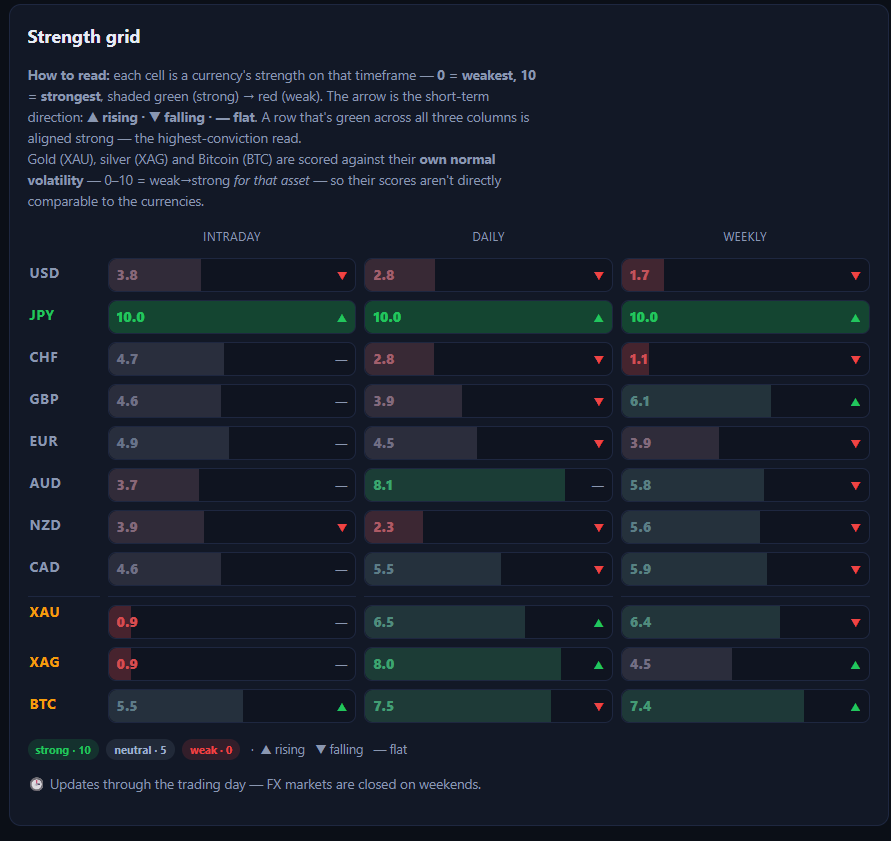
USD/JPY has fallen from roughly 160 to 153.5 in a matter of days. The Yen has strengthened against the US dollar, Australian dollar, British pound and Euro. For a currency that spent most of the past three years grinding weaker, a move this sharp demands attention.
The question is not simply "Why is the Yen rising?" The better question is: is this the beginning of a lasting regime change — or a violent unwind of an extremely crowded short-Yen position?
This article looks at the evidence and explains what would need to happen for the Yen's strength to become something more structural.
1. The Yen Has Started Moving
What Price Is Saying
Fact: USD/JPY has fallen from approximately 160 to 153.5 — a move of roughly 4% in a short period. The Yen has also strengthened against AUD, GBP and EUR, suggesting the move is broad-based rather than driven solely by US dollar weakness.
Compared to what?
- One year ago: USD/JPY was trading near 142. The Yen has weakened significantly over the past twelve months, even after this rally.
- The 2022 low: USD/JPY briefly touched 151.9 before intervention pushed it back.
- The long-term trend: the Yen has been in a broad depreciation trend against the dollar since 2021, driven largely by wide yield differentials.
Market interpretation: the speed of the move suggests positioning-driven flows — particularly short covering and carry-trade unwinding — rather than a gradual repricing based entirely on shifting economic fundamentals. Sharp moves over short periods can reflect traders closing existing positions rather than new long-term capital committing to a new view.
Our assessment: the Yen is strengthening, but the reason for the strength matters more than the magnitude. A 4% move driven primarily by short covering is very different from a 4% move driven by sustained capital inflows and a structurally narrowing yield gap.
Confidence: Medium. The price move is clear, but the durability of its underlying drivers is not yet established.
What would change our view: if USD/JPY stabilizes after the initial unwind, that would support the idea that positioning played the dominant role. If Yen strength continues even as positioning normalizes, the case for a more structural change becomes stronger.
2. Why Now? Three Forces
The Yen did not strengthen because Japan suddenly became a high-yield economy. It strengthened because the cost and risk of betting against it changed.
Force 1: BOJ Expectations Have Shifted
Fact: markets are increasingly pricing another Bank of Japan rate hike. BOJ board member Hajime Takata has discussed considering a broader range of policy options, and market pricing for the September meeting has moved toward expecting further tightening.
Compared to what? For most of the past three years, the BOJ was the major outlier. The market treated Japanese monetary policy as a constant — the one thing traders could count on not changing. That assumption is now being challenged.
Market interpretation: even a small hike — or hawkish guidance — changes the calculus for carry trades. If the cost of borrowing Yen rises, the profitability of Yen-funded positions falls.
Our assessment: the BOJ is moving slowly, but the direction has changed — and that matters more than the magnitude. For a market that built positions on the assumption that Japanese rates would remain extremely low, even a small shift in expectations can force significant repositioning.
Confidence: Medium-to-High. The BOJ has already hiked once. The question is whether this becomes a sequence or remains a one-off.
What would change our view: if the BOJ holds in September and Governor Ueda pushes back firmly against further hikes, the current "BOJ pivot" narrative would weaken and Yen strength could reverse.
Force 2: The Carry Trade Is Unwinding
Fact: the Yen's low funding cost made it attractive to borrow Yen and buy higher-yielding assets elsewhere. When expectations change, traders do not merely stop opening new carry trades — they close existing ones. Closing a Yen short requires buying Yen back, creating additional upward pressure on the currency.
Compared to what? Carry trades are built on stability. They work when the funding currency remains weak and the target currency remains strong. When the funding currency starts strengthening, the trade works in reverse — and because leverage is often involved, the adjustment can be fast.
Market interpretation: the Yen move has the hallmarks of a short squeeze. When a crowded trade starts moving against you, everyone tries to exit at once.
Our assessment: carry-trade unwinding explains the speed of the move better than the direction. It helps explain why USD/JPY can fall several yen in days rather than weeks. But it does not tell us whether the Yen will keep strengthening once the short covering is exhausted.
Confidence: High that positioning is a major contributor to the recent move; Medium that positioning alone can sustain a trend.
What would change our view: if speculative Yen shorts have been largely closed and USD/JPY continues falling, that would be more convincing evidence that new fundamental buyers are entering the market.
Force 3: Intervention Risk Has Changed
Fact: Japan has carried out large FX intervention operations in recent years, and the possibility of further intervention remains a background risk for anyone short the Yen.
Compared to what? Intervention is not a new tool for Japan, but its credibility can change with the broader policy environment. When the BOJ was firmly dovish, intervention could act as a temporary speed bump while the underlying yield differential continued pushing USD/JPY higher. If the BOJ is now moving toward tighter policy, intervention risk aligns more closely with the direction of monetary policy.
Market interpretation: traders may be less willing to fight the Ministry of Finance when the BOJ is also moving toward tighter policy.
Our assessment: intervention is a catalyst, not a trend. It can accelerate a move that is already developing, but it does not by itself create a lasting currency regime. For sustained Yen strength, the fundamental drivers — rates, growth and capital flows — still need to align.
Confidence: Medium. Intervention risk is real but unpredictable; the Ministry of Finance does not telegraph its moves.
What would change our view: sustained Yen strength without further intervention would be more convincing than a single intervention-driven spike.
3. Is This Actually a New Yen Regime?
This is the heart of the question. There are reasons to think the tide is turning — and reasons to remain cautious.
Reasons to Think Yes
Japan's economy is showing signs of life:
- Q2 GDP was revised up to 1.4% annualized.
- Real wages increased 2.4% year-on-year in July, suggesting inflation is increasingly being accompanied by gains in purchasing power.
- The BOJ has already hiked once and is discussing further adjustments.
For most of the past decade, Japan's story was stagnation — flat wages, flat prices and weak growth. The combination of stronger wages, inflation around target and a BOJ that is no longer permanently anchored at zero represents a genuine change from the previous regime. But that does not mean Japan has suddenly become a high-yield economy.
Reasons to Be Cautious
The US–Japan yield gap remains enormous. Even after the recent repricing, US 10-year Treasuries yield roughly 3.8–4.0%, while Japanese 10-year government bonds yield around 0.9–1.0% — still roughly a 300-basis-point gap. For institutional capital seeking yield, the US remains substantially more attractive than Japan.
Japan's structural vulnerabilities also remain:
- Japan remains a net energy importer.
- Fiscal deficits and an aging population continue to weigh on long-term growth expectations.
- The BOJ is moving gradually. One or two hikes do not erase decades of ultra-loose policy.
Market interpretation: the market is repricing the probability of a BOJ hiking cycle, but it has not yet repriced Japan as a high-yield destination. The Yen is strengthening because the worst-case scenario for Yen bears — permanent ultra-low rates and endless Yen depreciation — looks less likely. That is very different from the best-case scenario for Yen bulls becoming inevitable.
The most honest description is that the market has moved from one belief to another:
That uncertainty alone can be enough to force a large repositioning. Confidence: Medium — the trend has clearly changed direction, but its durability depends on the BOJ's next moves and whether US rates fall faster than Japanese rates rise.
4. What Would Make the Strength Sustainable?
A short squeeze can create a very large move. But a lasting currency trend requires new buyers to replace the traders who have already closed their shorts. There are three things worth watching.
BOJ: Does September Deliver?
The September BOJ meeting is the next major test. A hike with guidance suggesting more to come would validate the market's repricing. A hold combined with clearly dovish guidance would undermine it.
What to watch: the policy statement, Governor Ueda's press conference and the BOJ's economic outlook.
Yield Differential: Is the Gap Narrowing?
The US–Japan rate gap remains one of the most important fundamental drivers of USD/JPY. For the Yen to keep strengthening, one of two things needs to happen:
- US yields fall faster than Japanese yields rise, or
- Japanese yields rise faster than US yields.
What to watch: the 10-year yield differential, Fed Funds futures and BOJ policy expectations.
Positioning: Are New Buyers Entering?
If the Yen keeps strengthening after speculative shorts have been substantially reduced, that would be more significant. It could suggest genuine capital is flowing into Japan — through foreign investment, Japanese repatriation or both.
What to watch: CFTC positioning data and Japanese Ministry of Finance capital-flow data.
5. And What About CHF?
This is where the Yen story becomes a broader lesson. If traders are reducing Yen-funded positions because the Yen is no longer reliably cheap and stable, where does the funding-currency role go? One candidate is the Swiss Franc.
Fact: the Swiss National Bank's policy rate is currently 0%, while the 10-year Swiss Confederation yield is around 0.49%. That makes CHF mechanically cheap to borrow.
But there is a huge catch. CHF is also one of the world's major safe-haven currencies. When risk sentiment deteriorates — when stocks fall, geopolitical tensions rise or credit conditions worsen — CHF can appreciate. That creates a dangerous mismatch for anyone using it as a funding currency: you borrow CHF cheaply to buy risk assets, then risk assets fall and the currency you borrowed rises at the same time. Your losses can compound.
The Yen historically behaved differently. For much of the past decade it was the classic funding currency, because the BOJ's ultra-loose policy and wide yield differentials encouraged investors to move capital overseas. If the BOJ is now tightening, the Yen may begin behaving more like CHF — strengthening during risk-off periods as Japanese capital repatriates and Yen assets become relatively more attractive.
Our assessment: the search for the "next Yen" is premature. The Yen is not dead as a funding currency — it is simply becoming more expensive and potentially more volatile to use that way. CHF may be cheaper to borrow, but its safe-haven characteristics create a different risk profile.
There is no free lunch.
Confidence: Medium. The funding-currency hierarchy is evolving, but it will take months to see whether a new stable equilibrium emerges. What would change our view: if CHF starts consistently weakening when risk assets rally and strengthening when they fall — behaving like the old Yen — that would be stronger evidence that markets are treating it as a new primary funding currency. For now, its safe-haven properties remain an important distinction.
The Bigger FXStrength Lesson
A currency's strength isn't determined by its interest rate alone. It depends on the expected path of rates, the relative yield advantage, positioning, capital flows and the risk regime.
The Yen did not become strong because one indicator suddenly turned bullish. Several things started pointing in the same direction:
- BOJ expectations ↑
- Intervention risk ↑
- Carry positioning unwinding ↑
- US–Japan yield differential ↓
- Yen price strength ↑
When multiple pieces of evidence align, the story becomes much more interesting than when any single driver moves in isolation. That is the FXStrength framework:
Not "BOJ hawkish = buy Yen," but: BOJ expectations are shifting, carry trades are unwinding, and price is confirming the repricing. The weight of evidence has changed.
Key Takeaways
- The Yen has strengthened sharply, but the driver matters more than the magnitude — a short squeeze is different from a fundamental trend.
- Three forces are at work: shifting BOJ expectations, carry-trade unwinding and changed intervention risk.
- The regime is shifting, but has not yet changed. Japan is not suddenly a high-yield economy.
- Sustainability requires confirmation: continued BOJ tightening, a narrowing yield differential and Yen strength that survives the normalization of positioning.
- CHF is not a simple replacement for JPY as a funding currency — it is cheaper to borrow but carries safe-haven risk.
- Don't trade the headline. Follow the weight of evidence: one driver can create a move; multiple aligned drivers create a stronger case for a trend.
📖 What You Learned
A currency can move dramatically before the underlying economic regime has fully changed. The important question is whether the move is driven by a temporary positioning unwind or a lasting change in rate expectations and capital flows.
🔍 What Price Is Saying
The speed of the rally, and the fact that the Yen strengthened across multiple crosses rather than only against USD, point to positioning-driven flows — short covering and carry unwinding. For a lasting trend, we'd want continued Yen strength as positioning normalizes, plus a sustained narrowing of the US–Japan yield gap. For now, price confirms the repricing — not yet a full regime change.
🛠 How FXStrength Helps
When a currency starts moving sharply, the meter shows whether the strength is broad-based across JPY pairs or isolated to one cross, and whether the move is consistent with shifts in risk sentiment and yield differentials. It doesn't predict where USD/JPY goes next — it organizes the evidence so you can judge whether the weight of drivers supports the price move.
This article is part of the FXStrength Learning Path — see Why Some Economic Data Moves Markets — And Some Doesn't for more on how expectations and positioning drive currencies.
References
- MUFG Research — JPY Weekly, September 7, 2026.
- MUFG Research — JPY Monthly, September 2026.
- Reuters — Japan upgrades Q2 GDP on slight capex improvement.
- Swiss National Bank — Current interest rates and exchange rates.