Behind the Move · Issue #001 · Week 31, 2026 · Theme — When Expectations Change
Why Did AUD Fall After Softer-Than-Expected Inflation?
A softer Australian inflation print sent the Aussie lower — but price held key support, and the real story is a repricing of expectations, not a change of course at the RBA.
This week the Australian dollar fell after an inflation report came in softer than the market expected. The easy read — "lower inflation, weaker currency" — is the one most people reach for, and it quietly teaches the wrong lesson.
By the end of this you'll understand what actually moved the Aussie: not the number itself, but what the number did to expectations — and you'll see, on the chart, exactly where the market is testing that story.
What Happened
Australian inflation came in lower than economists expected. Not dramatically lower — just enough to make traders question whether the Reserve Bank of Australia (RBA) would raise rates again.
Investors quickly reduced their bets on another rate hike, and that repricing weakened the Australian dollar. It lost ground across much of the G10 — a broad currency move, not just one pair.
Why Expectations Changed
Before the report, traders were pricing in a meaningful chance that the RBA might hike again. Higher expected rates tend to support a currency; a softer inflation print nudges that calculation the other way. If price pressures are cooling faster than thought, the RBA has less reason to hike — so the market trims the odds, and the Aussie becomes a little less attractive at the margin.
The key move: the currency reacted to a change in expectations about the RBA — not to anything the RBA actually did. The bank didn't meet, didn't speak, didn't shift. And what didn't change matters just as much — inflation is still above the RBA's target, and one report rarely changes a central bank's entire stance. The data barely moved; the probability the market attached to it did.
What Price Is Saying
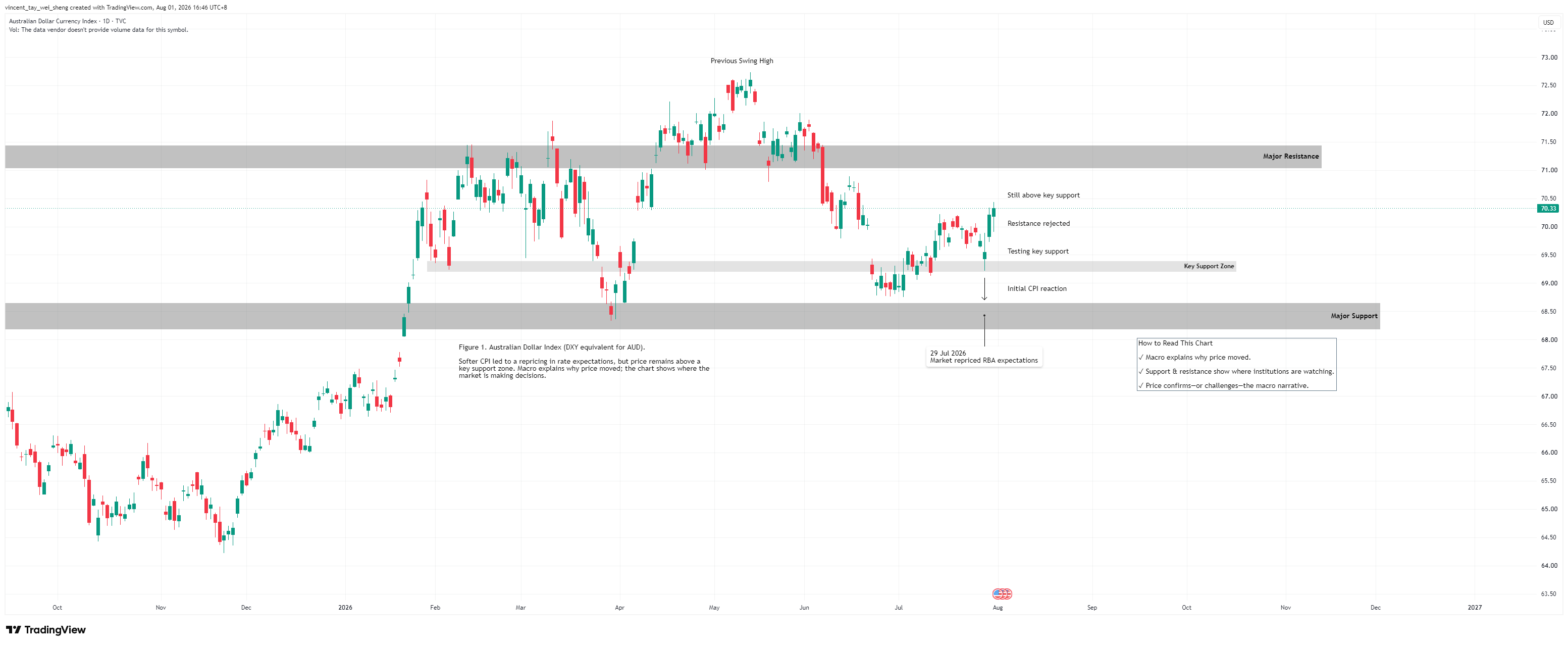
What Did Price Do?
Right after the 29 July release, the index sold off — the initial CPI reaction — sliding toward the key support zone near 69.3. But it didn't keep falling. Price tested that zone, held, and has since recovered back toward 70.3, still well above major support near 68.4 and some way below the May swing high near 72.5. Earlier in the move, rallies had been rejected at major resistance near 71.3.
Does Price Agree With the Macro Story?
Broadly, yes — and in a telling way. If the market had truly concluded the RBA was changing course, you'd expect the selling to push through the key support zone and head for major support. Instead, price found buyers at support and bounced. That's the footprint of a repricing of expectations — a contained reaction — rather than the start of a structural downtrend. Price is evidence, not proof: it confirms expectations shifted, but the hold above support says the market isn't yet convinced the RBA itself has pivoted.
Which Levels Matter?
Think of these as where the market is making decisions, not as places to trade. The key support zone near 69.3 is the line the CPI reaction tested and held — a decisive break below it would tell us conviction is building that the RBA story has genuinely changed. Below that, major support near 68.4 is the bigger structural floor. On the upside, major resistance near 71.3 and the May swing high near 72.5 cap the recovery. Watching how price behaves at these levels is how you tell a temporary repricing from a real trend — the macro explains why price moved; the levels show where the market is testing that story.
FXStrength Perspective
Every move is worth splitting into two questions: what changed — and what didn't?
What changed: the market's expectation for another near-term RBA hike, and with it short-term demand for AUD.
What didn't change: inflation is lower but still above the RBA's 2–3% target band; the RBA hasn't signalled a pivot; the labour market is still relatively resilient; and on the chart, price held key support rather than breaking down.
That balance is what makes this look tactical, not structural — a repricing of expectations inside an unchanged macro picture, rather than the start of a new regime. It's also worth remembering the Aussie isn't driven by domestic data alone; China, commodity demand, risk sentiment and the US dollar all pull on it.
Confidence: Medium — the CPI surprise was real, but it's a single print and the RBA hasn't confirmed anything. What would change this view: two consecutive soft inflation prints, or a clear signal from the RBA that it is pausing — and on the chart, a decisive break of the key support zone would say the same thing.
Lesson #001
The beginner mistake is reading a headline like "inflation lower" and assuming the currency must weaken. It depends on what was already priced in — a soft print can even lift a currency if the market had braced for something worse. The better question to ask: did this news change anyone's expectations? If not, the move is smaller than the headline suggests. If yes, even a "small" story can move price a long way.
Key Takeaways
- AUD fell because expectations for another RBA hike were trimmed — not because the RBA changed course.
- Markets trade surprises versus what was priced in, not raw good-or-bad data.
- Inflation is lower but still above target; one print is tactical, not structural.
- Price held the key support zone and recovered — a contained repricing, not a new downtrend.
- What to watch: Australian employment and the next inflation print — and, on the chart, the key support zone near 69.3.
What You Learned
Markets move on changes in expectations, not on headlines. A number only matters relative to what was already priced in.
What Price Is Saying
Price held key support and bounced rather than breaking down — the footprint of a repricing, not a new trend.
How FXStrength Helps
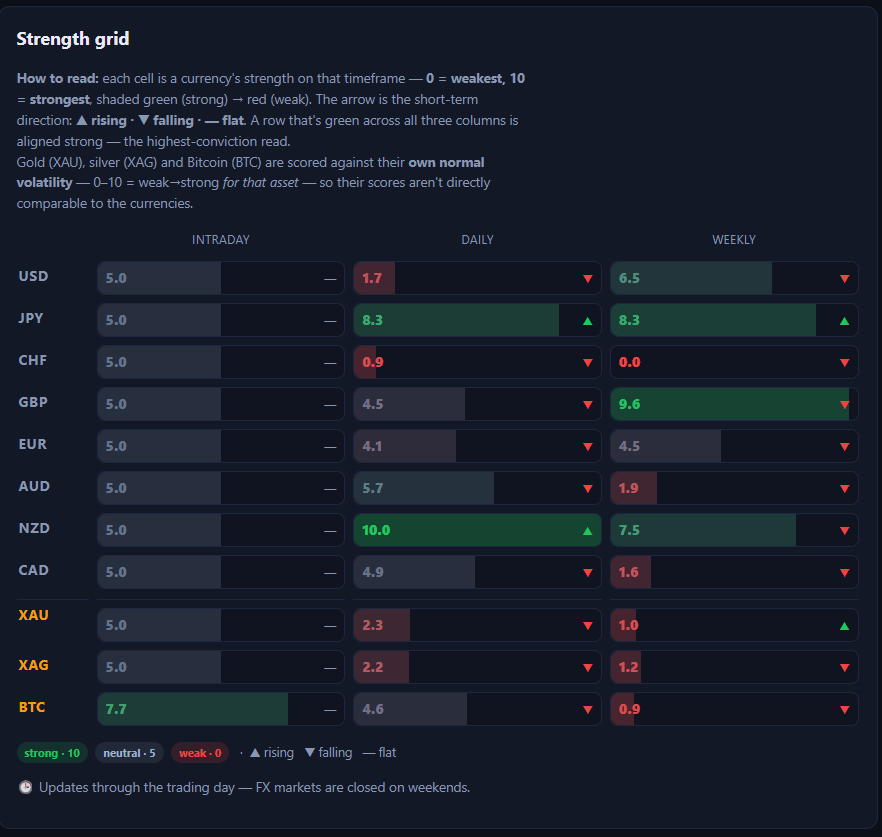
The strength meter shows whether AUD weakness is broad (a real currency story) or just one noisy pair — and whether the daily and weekly reads agree.