Behind the Move · Issue #002 · Week 32, 2026 · Theme — When the Surprise Changes the Picture
When the Surprise Changes the Picture
US payrolls fell 23,000 against +85,000 expected. The lesson isn't that the number was negative — it's how far it landed from what markets had spent all week pricing in. That gap is why the surprise matters more than the number.
Part 1 — The Week in Macro
This Week in 60 Seconds
- China manufacturing weakened. The official PMI fell to 49.2, while the Caixin PMI dropped to 50.9, below the 51.5 forecast.
- US labour data sent mixed signals. JOLTS job openings were little changed at 7.44 million, broadly in line with expectations. ISM Services showed strong business activity at 59.1, but employment fell into contraction at 47.4.
- The US services economy remained resilient, making the growth picture less straightforward.
- Then NFP changed the picture. July payrolls fell by 23,000 versus +85,000 expected. Unemployment dipped to 4.1%, while average hourly earnings rose just 0.1% m/m.
The interesting part wasn't that markets ignored the data. They were using it to build a view of what might come next — until Friday delivered a much bigger surprise than expected.
Part 2 — Markets Were Pricing Friday Before Friday Arrived
Every week, markets receive new information. But not every piece of information creates an immediate move.
This week showed why — and Friday showed what happens when new information is very different from what the market expected.
Story 1 — China: One Clue Among Many
Fact: China's manufacturing data weakened in July. The official NBS Manufacturing PMI fell to 49.2, down from 50.3 in June, slipping below the 50-point threshold that separates expansion from contraction. The Caixin/RatingDog Manufacturing PMI came in at 50.9, down from 51.7 and below the 51.5 forecast.
Market interpretation: This was important for AUD, NZD and commodities. But the market did not treat it as a standalone reason to make a major directional move.
Our assessment: A piece of data can change the information set without completely changing the market's forecast. China was one part of the information being processed this week.
Confidence: Medium. The headline manufacturing data weakened, but high-tech manufacturing remained in expansion at 53.3.
What would change our view: A sustained series of sub-50 PMI prints would shift the China growth narrative from a soft patch toward a more persistent slowdown.
Story 2 — US Data: More Clues, Mixed Messages
Fact: The US delivered two important labour-market signals.
- JOLTS (June): Job openings were little changed at 7.44 million, broadly in line with expectations. Hires held at 5.3 million. The quits rate stayed at 2.0% and layoffs at 1.1%.
- ISM Services (July): The headline PMI edged up to 54.1. Business Activity jumped to 59.1, but Employment fell back into contraction at 47.4 from 51.2.
Market interpretation: The message wasn't simply "US economy strong" or "US economy weak." It was more complicated. Growth looked resilient. Labour showed signs of cooling.
Our assessment: This is exactly the sort of mixed information markets have to weigh when assessing the outlook for interest rates. The services sector was expanding, but its employment component was contracting. That tension made Friday's NFP particularly important.
Confidence: Medium. The low-hire, low-fire environment persisted, but these indicators alone did not establish a decisive deterioration in the labour market.
What would change our view: Further deterioration across hiring, payrolls and unemployment would provide stronger evidence that the cooling labour market had become a broader trend.
Story 3 — Why NFP Mattered More
NFP wasn't important simply because it was a "big number." It was important because the market had spent the entire week collecting clues about the US labour market.
JOLTS gave one clue: job openings were broadly unchanged, while the low-hire, low-fire environment persisted. ISM Services Employment gave another: contraction within a growing sector. Then NFP provided a much larger piece of evidence.
That's Lesson #002 in action.
Story 4 — NFP: The Test Delivered a Surprise
Fact: The July NFP report, released Friday, August 7, showed US nonfarm payrolls fell by 23,000, versus expectations for an increase of 85,000. The unemployment rate dipped to 4.1% from 4.2%, while average hourly earnings rose 0.1% month-on-month, below the 0.3% expected.
Market interpretation: The payroll number was dramatically weaker than expected. At the same time, the unemployment rate fell and wage growth remained positive. The result was therefore not a simple "everything is weak" report.
Our assessment: This report forces markets to reconsider the outlook for the US labour market. The important point is not simply that payrolls fell. It is that the result was dramatically different from what markets had expected. That is what creates the potential for a rapid change in expectations.
The report also leaves an important question unanswered: is this the beginning of a broader deterioration, or an unusually weak monthly reading? One report cannot answer that on its own.
What changed: The case for a softer US labour-market outlook became significantly stronger, putting the previous "patient Fed" interpretation under pressure.
What didn't change: The Fed has not changed policy because of one report. Unemployment remains relatively low, wage growth is still positive, and the services economy remains resilient.
Compared to what?
Expected
+85,000 jobs
Actual
−23,000 jobs
The surprise
108,000 jobs between expectation and outcome
This is exactly why comparing the number with expectations matters more than looking at the number in isolation.
What was already priced in: Before the release, the market had been weighing a patient, data-dependent Fed. The size of the payroll surprise provides a strong reason for that baseline to be reassessed.
Confidence: Medium. The payroll number was a major downside surprise, but the lower unemployment rate and still-positive wage growth make the overall labour-market picture more complicated than the headline alone suggests.
What would change our view: Further weak payroll reports accompanied by rising unemployment would strengthen the case that July marked the beginning of a broader labour-market deterioration. A strong rebound in subsequent employment data would weaken that interpretation.
Lesson #002
This week, the early data gave markets additional clues about the labour market ahead of NFP. Those clues helped frame what traders would be looking for. Then Friday delivered −23,000 payrolls versus +85,000 expected. The surprise wasn't simply that the number was negative — it was how far the result was from the market's expectation. That's why the surprise matters more than the number itself.
Market Behaviour
Is price behaving consistently with this week's macro story?
The week began with relatively contained price action as markets processed incoming information without a decisive change in expectations. Friday introduced a much larger piece of information. The question now is whether price continues to reflect that change in expectations.
What did price tell us?
Before NFP, the contained moves suggested markets were processing information sequentially rather than reacting to each headline in isolation. That itself was useful information. After NFP, the important question is whether the initial reaction develops into a sustained repricing.
Price is evidence, not proof. A sharp first move can tell us that expectations changed. It does not, by itself, tell us that the new narrative will persist.
Technical Watch — DXY
102 remains the key level. The Dollar Index had previously reversed from the 102 area, which now stands out as an important level on the chart.
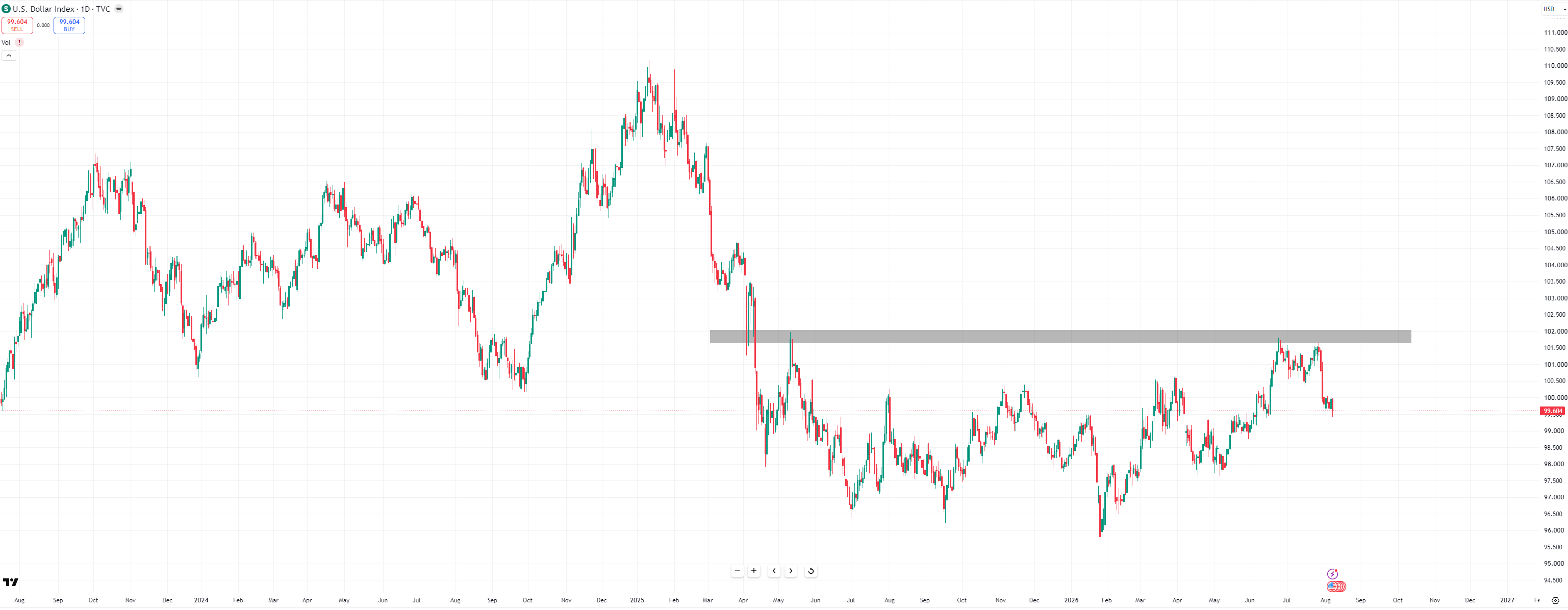
Going into NFP, the question was whether the US labour report could push DXY back toward that area. Instead, the large downside payroll surprise leaves us watching something different: does DXY continue lower, or can the dollar recover toward 102 despite the weaker labour-market data?
We don't need to predict the answer. 102 is the level. Price will tell us whether the market is actually changing its view of the dollar.
Part 3 — On Our Radar
Fed communication. The next question is how Fed officials respond to the weaker labour-market data. Their comments will help markets assess whether the NFP result is being treated as an isolated surprise or evidence of a broader change.
US CPI. Inflation remains the other important part of the interest-rate picture. A weak labour report does not automatically determine the path of policy.
China policy response. With manufacturing activity weakening, watch whether Beijing signals additional policy support — or whether the slowdown becomes more persistent.
Question of the Week
Think About This
Before reacting to next week's biggest headline, ask yourself: Was the market already trying to price this in — and if so, what would have to surprise for the price to actually move?
See you next week.
What You Learned
Markets price the future, not the present. A number only matters relative to what was already expected — the surprise is the story.
What Price Is Saying
102 is the DXY level. Whether the dollar continues lower or recovers there tells us if the market is really changing its view.
How FXStrength Helps
The strength meter shows whether post-NFP USD weakness is broad — a real currency story — or just one noisy pair, and whether daily and weekly reads agree.